
Introduction
In Part I of this series, we introduced the idea that drug candidates emerging from artificial intelligence may have to be valued differently than those emerging from more traditional approaches to drug discovery.
Part II extends this discussion and focuses on the many complex IP issues that emerge when AI enters the drug discovery room. We also pose questions about how these IP issues can influence valuation in ways traditional drug discovery does not.
We now continue this discussion and enter into the murky world of AI’s contribution to drug candidate valuation.
Quantifying the AI Contribution
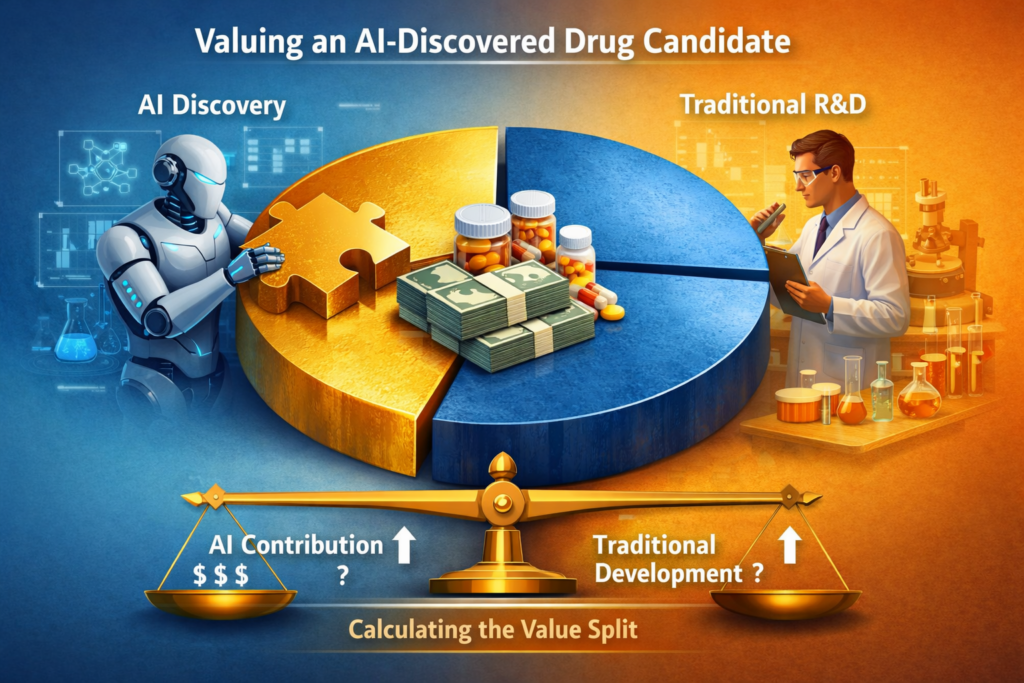
Even when if IP ownership is clearly established, licensing negotiations face a more fundamental challenge. Namely, how do you quantify what portion of a candidate’s value should be attributed to the AI discovery method versus traditional development work?
This isn’t a hypothetical problem.
Consider a typical AI drug discovery collaboration.
An AI platform identifies a novel target by analyzing multiomics data, generates lead compounds through computational design, and the pharma partner then conducts medicinal chemistry optimization, preclinical studies, manufacturing scale-up, and clinical trials.
Ok. Fine.
When that candidate eventually reaches the market, what percentage of its commercial value resulted from the AI’s contribution versus the tens of millions spent on traditional development activities?
Does this matter?
You bet.
If the AI platform’s contribution was truly transformative, i.e., identifying a target no human would have found, or designing a molecule with a safety/efficacy profile far superior to what medicinal chemistry would have produced, then high Upfront payments and high Royalties may be justified.
But if the AI simply accelerated target identification by a few months, or generated a starting point that required extensive optimization, the computational contribution may warrant only modest economics.
Deal structures in 2025-2026 show heavy reliance on milestone-based payments. The Monte Rosa-Novartis deal, for example, includes $120 million upfront focused on the AI platform’s molecular glue degrader discovery capabilities, but then layers on up to $2.2 billion in development milestones and $3.2 billion in commercial milestones. The XtalPi-DoveTree partnership follows a similar pattern: $51 million upfront against $5.9 billion in potential milestones.
Is this backloading driven by uncertainty about AI-derived candidates specifically, or simply a shift in the “standard” valuations for early-stage assets regardless of discovery method?
In our view, it’s likely both.
The shift toward contingent payments linked to trial outcomes or sales thresholds is common across all early-stage licensing deals, AI or otherwise. However, the particularly dramatic ratios in some AI deals (upfronts representing less than 1% of total potential value) may reflect additional uncertainty about whether computational discovery actually produces superior candidates.
If the relatively modest upfront payments in AI deals are indeed driven partly by uncertainty about the AI contribution’s value, we should expect to see upfronts rise over time as clinical data validates (or fails to validate) the computational approach.
If AI-discovered candidates consistently demonstrate faster development timelines, higher clinical success rates, or superior commercial performance, licensees should become willing to pay more upfront for computationally-derived assets.
Conversely, if AI candidates perform no better than traditional discovery, the “AI premium” in deal economics should disappear entirely.
The challenge becomes even more acute when AI is used at only one stage of discovery.
If an AI platform identifies a target but traditional high-throughput screening finds the lead, or if traditional target identification is followed by AI-driven molecular design, how should the economics be split? How do we even model this?
One practical approach is to separate platform access fees from asset-specific payments.
Under this model, the prospective Licensee pays for the right to use the AI platform (essentially a technology access or a service fee) plus separate economics tied to specific candidates that emerge.
This acknowledges that the AI tool has value, but doesn’t automatically assume every output deserves premium pricing.
The asset-specific economics can then be valued as normal, with adjustments only if the AI-derived candidate demonstrates measurably superior characteristics.
These can even be structured as Options, where the License is executed upon the delivery of drug candidates “on paper” with specific characteristics or even performance in initial in vitro or in vivo studies.
For BD&L teams, the key is resisting the temptation to pay for “AI-ness” as an abstract premium.
Instead, licensing terms should tie compensation to demonstrable value creation, such as faster timelines (milestone acceleration), better candidates (clinical success bonuses), or novel targets (premium royalties on first-in-class assets).
Until AI-discovered drugs prove systematically superior commercial performance, attributing specific economic value to the computational contribution remains more art than science, and deal structures should reflect that uncertainty.
Key Takeaways
- Quantifying AI’s contribution versus traditional drug development contribution remains challenging because it’s unclear how much value comes from computational discovery versus wet-lab validation and clinical execution
- Heavily milestone-weighted structures (upfronts of ~1% of total value) may reflect uncertainty about computational value on top of standard early-stage risk
- Using Option-like structures to separate platform access fees from asset-specific payments provides a framework for valuing AI tools without automatically paying premiums for every output
- BD&L teams should tie AI economics to demonstrable value (speed, efficacy, novelty) rather than paying abstract premiums for computational provenance
Coming Up in Part IV: Platform versus Molecule Valuation
AI drug discovery introduces a unique transaction choice. We can licensing specific molecules, or we can access the computational platform itself (or both). These two models require fundamentally different valuation approaches, and applying the wrong framework can lead to poor deal decisions.
In our next post, we’ll examine how to value platform optionality versus discrete asset risk-reward, and when each model makes strategic sense.
NB: LLMs were used for some of the research aspects of this post.