
Introduction
In Part I of this series, we introduced the idea that drug candidates emerging from artificial intelligence may have to be valued differently than those emerging from more traditional approaches to drug discovery.
Part II extends this discussion and focuses on the many complex IP issues that emerge when AI enters the drug discovery room. We also pose questions about how these IP issues can influence valuation in ways traditional drug discovery does not.
Part III enters into the murky world of AI’s contribution to drug candidate valuation. We asked questions (but did not answer them) about licensing candidates versus providing access to the underlying AI platform.
We now extend the Part III discussion to tackle the Platform versus Candidate question, and the impact on valuation.
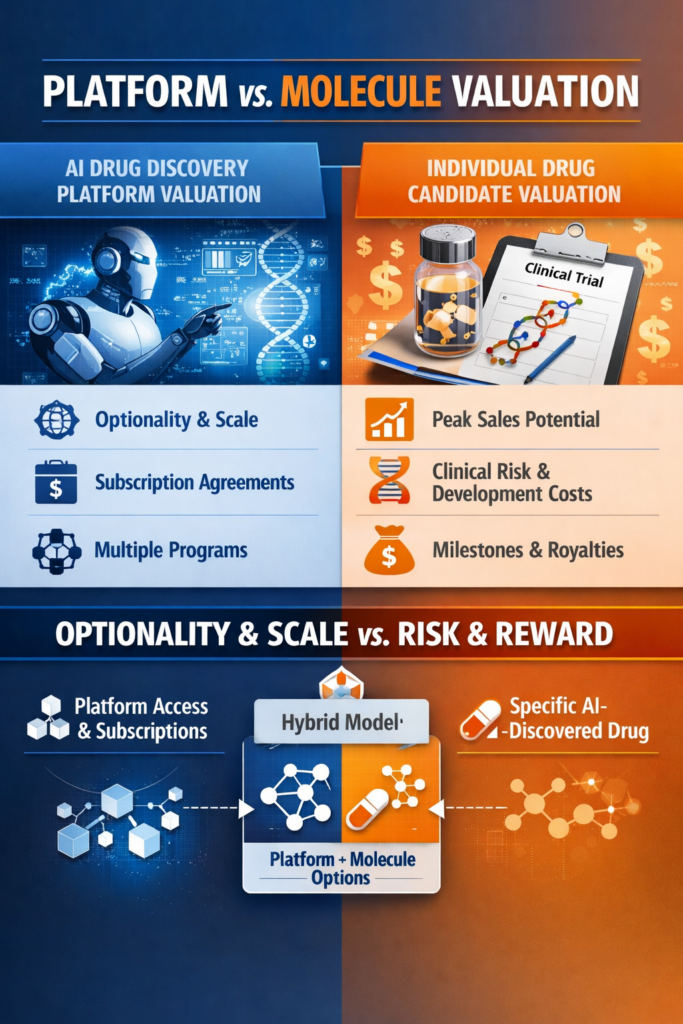
Platform vs. Molecule Valuation
A feature of AI drug discovery licensing is the choice between two fundamentally different models: licensing specific AI-discovered molecules versus licensing access to the AI platform itself…or both.
This platform-versus-asset decision creates unique valuation challenges that don’t exist in traditional drug discovery deals.
In traditional licensing, a Licensor grants specific rights to a specific candidate, and the economics reflect the risk-adjusted expected (hoped?) value of that particular candidate, under the terms and conditions of the license.
That’s it.
But AI introduces a different possibility.
Instead of licensing discrete molecules, a company can access the computational platform, essentially buying (or, renting, if you prefer) the ability to generate multiple candidates across different targets or disease areas.
Recent major deals illustrate this bifurcation. In January 2026, Eli Lilly announced a $1 billion partnership with Nvidia to build a co-innovation AI lab, staffed by combined teams from both companies.
This wasn’t a deal for specific drug candidates. It was an investment in platform capabilities to address key challenges across Lilly’s entire drug discovery pipeline.
Similarly, when GSK partnered with Noetik for $50 million upfront plus subscription fees (note the word subscription here) to access AI models in cancer, or when Pfizer collaborated with Boltz to deploy biomolecular AI foundation models across the company, these collaborations focused on deploying AI platforms across diverse applications rather than licensing specific molecules.
These platform deals contrast sharply with molecule-specific transactions like Helixon’s $1.7 billion licensing agreement with Sanofi, which granted rights to specific AI-designed antibody therapeutics, or the various XtalPi partnerships that focus on defined AI-discovered compound programs.
So how should licensees value platform access versus molecules?
For molecule-specific deals, valuation can follow traditional frameworks: estimate peak sales, development costs, transaction costs, adjust for probabilities of success, and discount back to net present value.
Standard licensing metrics (Upfront, Milestones, & Royalties) will apply.
No problem.
Platform deals, by contrast, require valuing optionality and throughput.
Key questions may include:
- How many programs can the platform realistically support?
- What is the expected quality improvement over internal discovery capabilities?
- How dependent will we become on the platform provider?
- What happens if the platform underperforms or if better technology emerges?
Investors. Take note.
There’s also a hybrid model emerging: platform access agreements with options on specific molecules.
As one industry analysis notes, portfolio strategy is shifting toward hedged sets of options, and platform deals inherently provide this diversification, but at the cost of significant upfront commitment without guaranteed outputs (cf., Lilly & Nvidia).
Indeed, option-based modeling may be a good way to think about these relationships.
We really like this approach because it provides access to technology while retaining optionality and lock in the “first look” status for anything that emerges.
The AstraZeneca-CSPC partnership exemplifies this. CSPC conducts research using its AI platform, while AstraZeneca holds exclusive options to license programs that may emerge.
This structure lets the Licensee evaluate platform output before committing to specific assets, reducing risk while maintaining access to the discovery engine.
Beautiful.
For BD&L teams, the platform-versus-molecule decision, as always, hinges on strategic priorities.
If you need discovery capabilities across multiple programs and believe the AI platform represents a sustainable competitive advantage, platform access (via subscriptions, options, etc.) may justify significant investment.
Note that this is a much longer-term commitment. It may be years before a potential candidate emerges from the platform collaboration. This is not an arrangement for Licensees in a hurry to fill a Revenue gap.
But if you’re evaluating a specific promising candidate that happens to be AI-discovered, pay for the molecule based on its clinical and commercial potential, and not for the computational infrastructure that created it.
The valuation challenge ultimately comes down to this: platforms provide optionality (there is that word again) and scale over time, while molecules provide defined risk-reward profiles over a slightly shorter time horizon (especially for more advanced candidates, obviously).
They’re not directly comparable, and attempting to value them using the same framework may lead to poor decisions.
Key Takeaways
- AI licensing offers two distinct models: licensing specific molecules versus licensing platform access, each requiring different valuation frameworks
- Platform deals value optionality and throughput across multiple programs
- Molecule deals follow traditional licensing metrics based on specific asset risk-reward profiles
- Hybrid models (platform access with molecule options) let licensees evaluate AI output before committing to specific assets
- The right choice depends on strategic needs, not inherent superiority of either model. Trying to value platforms and molecules with the same framework leads to poor decisions.
Coming Up in Part V: Data Quality and Validation Standards
In Part V, we conclude this series by discussing training data quality.
The quality and innovativeness of AI-discovered candidates relies on the training data and computational validation used during discovery.
This creates tremendous valuation uncertainty that doesn’t exist with traditionally-discovered molecules.
In our final post, we’ll examine how data quality impacts deal negotiations, what due diligence questions licensees should ask, and why transparency about training datasets and validation metrics should be contractual requirements, not optional disclosures.
NB: LLMs were used for some of the research aspects of this post.