
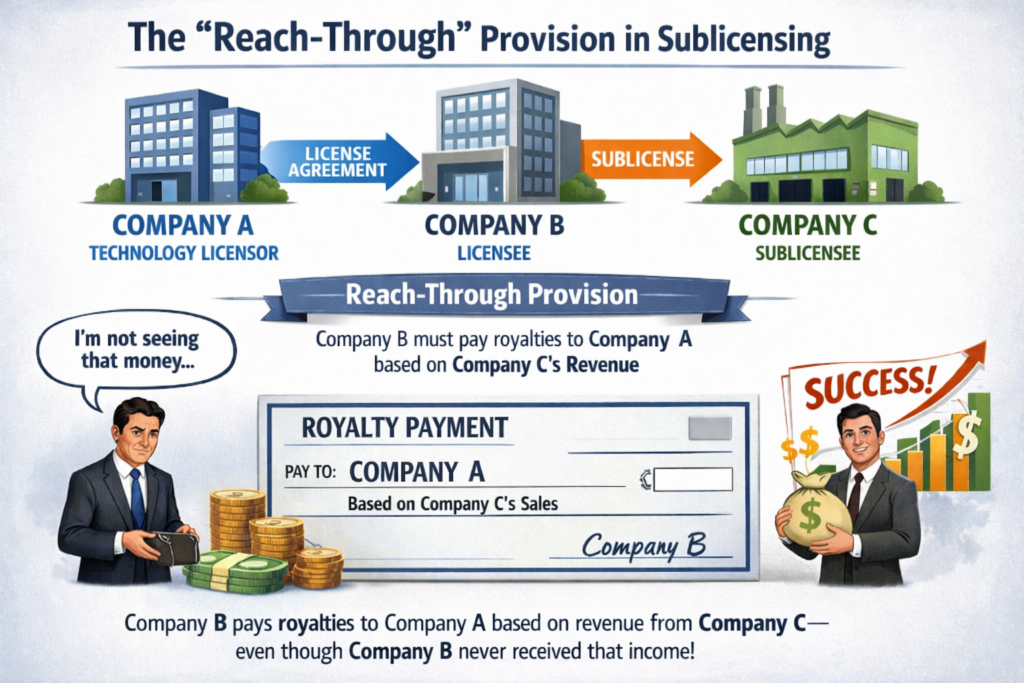
What is a “reach through?
Let me paint the picture.
Company A licenses technology to Company B.
Company B then sublicenses to Company C.
Under a reach-through provision, Company B owes royalties to Company A based on Company C’s commercial success.
Essentially, Company B is writing checks based on revenue they never directly received.
Is this standard practice?
We cannot say for sure if it is “standard”, but it is fairly common.
For example, look at the WARF “non negotiable” term sheet here. It clearly states,
2% royalty on the Selling Price of Products and Services sold by Licensee or a Sublicensee [Our emphasis]
To repeat, the Sublicensee sells the product containing the licensed IP, but you as the original Licensee now owe the Licensor what is essentially a Royalty on the Net Sales generated by the Sublicensee…and act over which you have essentially no control.
Note this is beyond the usual and customary sharing of Sublicensing Transaction Expenses, such as upfronts and milestones.
So Why Agree to This?
There may be a few reasons why an initial Licensee would agree to this.
First, it may simply be the cost of doing business. If the intellectual property is unique and valuable (and the Licensor recognizes it was such), then it may be the price to pay to gain access to the technology.
This is actually quite reasonable if it is clear that the Licensee will commercialize the technology. And financial modeling may suggest that it’s worth the risk.
Second, it is possible that the original Licensee never envisioned having a Sublicensee be involved in the future. But now the Licensee is stuck paying bills without the associated Revenues.
How to Resolve This?
The key to this is in the financial modeling. However, modeling sublicenses is incredibly difficult because a Licensee can never be sure if or when they will happen, and how much they will be worth.
There are legal mechanics to deal with this, such as “Kick the Can” scenarios, where a Licensor and Licensee agree to delay negotiating sublicensing economics until a Sublicensee Term Sheet is presented.
Ultimately, it’s a discussion and decision to be entered into with the advice of a solid deal attorney, some robust financial modeling, and a check on the risk tolerance of the Board.
This should not be interpreted as legal or financial advice. We can guide you through some of these issues, but always seek the advice of an experienced attorney before executing any contracts or other agreements.