How AI Changes the Math of In-Licensing — Part A
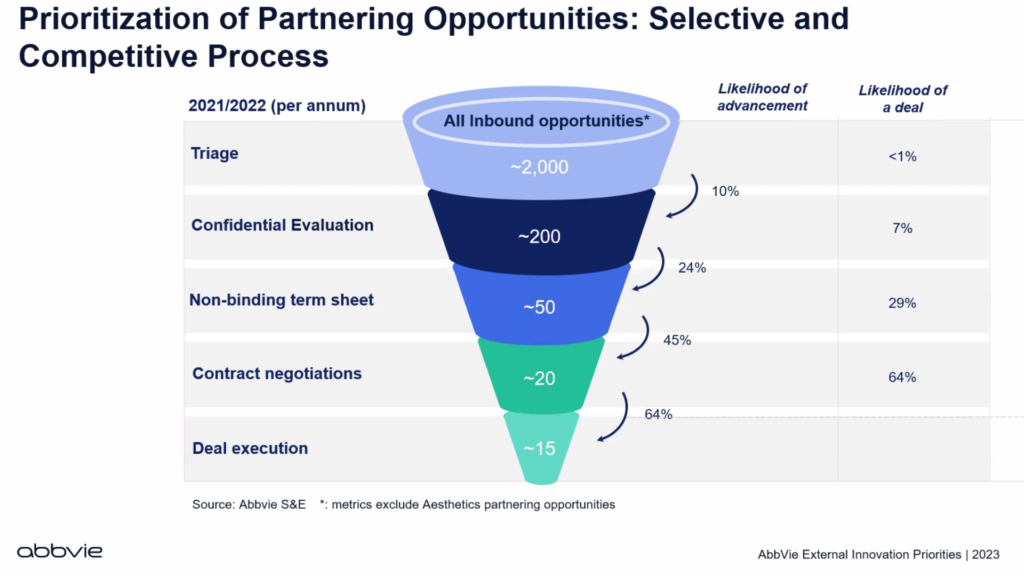
Every licensing executive has seen some version of this chart. AbbVie disclosed its own numbers a few years back: roughly 2,000 inbound partnering opportunities a year, narrowing to about 200 that reach confidential evaluation, 50 that reach a non-binding term sheet, 20 in contract negotiations, and around 15 deals actually executed.
The net result: an overall likelihood of a deal from that first inbound contact is under 1%. And AbbVie is far from unique in this aspect.
It’s a familiar shape. It’s a funnel that is wide at the top and narrow at the bottom, as it should be. The question worth asking is what, exactly, is doing the narrowing, aside from limits on development resources and capacity.
Is it that 99% of what comes in the door genuinely isn’t worth pursuing? Or is it that no BD organization, however well-resourced, can run full diligence on 2,000 opportunities a year with the staff it has?
I think it’s mostly the second. And I think that’s about to change because AI changes what a licensing team can afford to look at closely before saying no.
Why the Funnel Is Narrow Today
The real bottleneck isn’t interest. It’s the confidentiality disclosure agreement and the activities that follow.
Once a CDA is signed, it creates an obligation: real analyst hours, IP review, clinical and CMC scrutiny, a place in the queue.
Because that obligation is expensive, teams must make triage decisions before signing anything, working from whatever evidence is available pre-CDA, such as published data, competitive landscapes, portfolio fit, market and KOL intelligence, etc.
That’s genuine, evidence-based judgment, but it’s necessarily partial, and the number of opportunities that can get a full workup in a given year is partially capped by headcount, not by how many are worth a closer look.
The constraint is bandwidth, not rigor.
How AI Widens the Mouth of the Funnel
This is where AI-assisted diligence changes the arithmetic.
AI-driven workflows that include first-pass IP landscaping, structured extraction from data rooms, automated data comparisons and rNPV scaffolding lower the marginal cost of signing the next CDA.
The limiting question shifts from “how many opportunities can we humanly evaluate this year” to “how many can we digitally triage well.”
A team that could responsibly carry 200 signed CDAs a year might responsibly carry meaningfully more, without adding headcount, because the expensive part of early diligence gets cheaper per opportunity.
What That Implies
Digital search grows as a discovery channel, but it doesn’t replace conference floors and relationship-based sourcing anytime soon. In our view, the two will overlap for a long time. What changes is the ratio, and the floor: assets that would never surface through a major partnering event become findable digitally.
Licensors must become “AI-ready.” A data room built for a single external human analyst and a slow read is a liability if the counterparty’s first pass prefers to run through an agent.
Structured, machine-readable evidence (and no more slides with six tiny graphs) becomes a marketing requirement, not just a diligence convenience.
Smaller BD teams can screen and evaluate more per head, which narrows the volume advantage that large licensees have historically held.
But that advantage is only real if it’s backed by development capacity. Indeed, screening more candidates than you can ever fund or staff to develop is just a longer list of things you said “No” to more carefully. (Part B picks up on this point.)
There’s also a real expansion in what’s worth evaluating at the failure end of the pipeline.
An asset that missed its primary endpoint in Phase IIa isn’t automatically dead, especially if the miss was about population selection, dosing, or an underpowered design rather than mechanism or safety. Somewhere in the data, there may be a credible rescue story.
AI-assisted feasibility work makes that story cheap to test before anyone signs anything: synthetic control feasibility checks against real-world data, biomarker-defined responder re-analysis, matched adjusted indirect comparisons, in silico dose-response remodeling, and even virtual clinical studies are now possible.
None of it replaces a real study, but it can produce a first-pass rescue thesis cheap enough to justify signing the CDA in the first place. It’s the same logic that makes scouting discontinued candidates for acquisition work at all, generalized to in-licensing.
There’s a more speculative fifth implication: long-tail, niche-indication assets that were previously too small to earn a human analyst’s attention might become cheap enough to screen at all.
Part B continues this discussion by discussing where the funnel stays narrow no matter how good the screening gets, and what, if anything, actually improves on the other side.