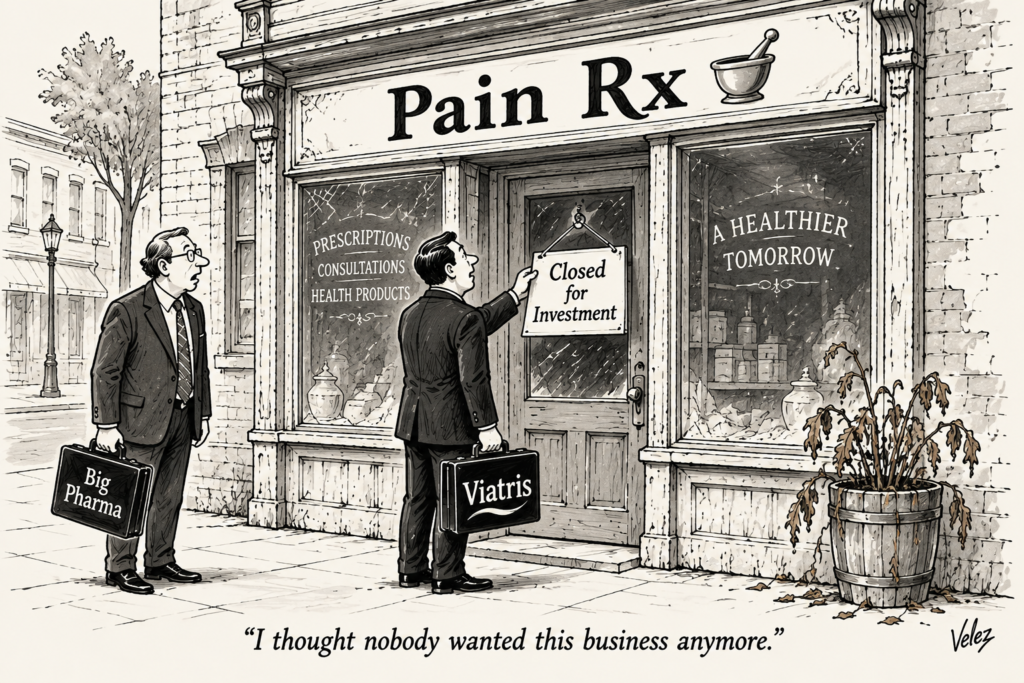
Earlier today, Viatris agreed to acquire Pacira BioSciences for about $1.65 billion. Most coverage spins it as a generics company pushing into innovative medicines.
Indeed, that is one way to interpret this story.
But the other is that a major company just paid real money to lead in non-opioid pain, a field that investors and licensors avoided for most of the past decade.
Both stories matter to BD teams. Pain has long been one of the hardest areas to fund or partner, and generics companies are rarely on the buyer lists that sellers build.
This deal suggests both assumptions might deserve a second look.
Angle one: non-opioid pain is investable again
For most of the last decade, pain was a field that all capital avoided.
A 2023 BIO analysis found that clinical-stage pain programs fell from 220 to 124 between 2017 and 2022, a 44% drop. Only 1.3% of therapeutic venture capital, about $228 million, went to pain and addiction companies in 2021. According to Fierce Biotech’s coverage of that report, just 0.7% of new pain drugs made it from Phase 1 to approval.
The reasons are clear: high placebo responses, subjective endpoints, a crowded generic market, the reputational shadow of the opioid crisis, and the existence of other opportunities that are actually lower risk and with a higher reward potential.
Understandably, big pharma walked away.
But three things have changed since then.
A new drug class proved the market exists. In January 2025 the FDA approved Vertex’s Journavx (suzetrigine), a NaV1.8 inhibitor and the first new class of pain medicine in more than 20 years.
Uptake started slowly, with $59.6 million in 2025 revenue. It is now accelerating. Journavx earned $50 million in Q2 2026, up 71% on the prior quarter, with nearly 900,000 prescriptions filled in the first half of the year. Vertex has added Medicare Part D coverage through two more major PBMs, and 23 state Medicaid programs now cover it.
Reimbursement policy now favors non-opioids. The NOPAIN Act requires Medicare to pay separately for qualifying non-opioid pain treatments in hospital outpatient departments and ambulatory surgery centers, rather than bundling them into the procedure payment.
That removed a long-standing cost barrier for products like Exparel, which Pacira confirmed qualified from January 1, 2025. CMS added Journavx to the qualifying list in January 2026. The separate payment currently runs through December 31, 2027, so renewal is a policy risk worth watching.
The opioid reckoning has reset the incentives. Large opioid settlements, including Purdue and the Sacklers’ $7.4 billion agreement, have made opioid-sparing care a priority for payers, hospitals and policymakers. Viatris has its own opioid history to move past, having agreed to pay $335 million to settle opioid claims in 2025.
But the science is still hard. Vertex’s follow-on NaV1.8 inhibitor, VX-993, failed to beat placebo in a 2025 Phase 2 acute pain trial. The FDA has also signaled it sees no path to a broad peripheral neuropathic pain label for Journavx.
Pain remains a field where the market is very large but the clinical and commercial risks are high.
A thin but growing deal record
The recent non-opioid deal record is short enough to fit in one table. Viatris/Pacira is the largest transaction on it by a wide margin.
| Date | Deal | Type | Value | Asset and stage |
| Oct 2026 | Viatris / Pacira BioSciences | Acquisition | $1.65B equity | EXPAREL, ZILRETTA(marketed); PCRX-201 (Phase 2) |
| Apr 2026 | AbbVie / Haisco | Ex-China license | $30M upfront; up to $745M total | Two NaV1.8 inhibitors (Phase 1 IV; preclinical oral) |
| May 2025 | Lilly / SiteOne Therapeutics | Acquisition | Up to $1.0B incl. milestones | STC-004, NaV1.8 (Phase 2-ready) |
| Mar 2025 | Latigo Biotherapeutics | Series B | $150M | NaV1.8 inhibitors (Phase 2 acute; Phase 1 chronic) |
| Oct 2021 | Pacira / Flexion Therapeutics | Acquisition | $8.50/share (~$425M) + CVR up to $8.00 | ZILRETTA (marketed) |
Three features stand out. First, most of the novel-mechanism activity crowds onto a single target, NaV1.8, behind Vertex.
Second, the novel deals are heavily back-end loaded. AbbVie paid just $30 million upfront for Haisco’s two programs, and Lilly’s headline $1 billion for SiteOne includes regulatory and commercial milestones.
Third, the only deals with large, guaranteed cash involve marketed products. Buyers in the pain space are still paying for evidence, not mechanisms.
Pacira’s own history shows the pattern. It bought ZILRETTA when Flexion was selling just $21–23 million a quarter, and used a CVR worth up to $8 per share to bridge the valuation gap. Five years later, ZILRETTA is one of the two marketed products Viatris just bought.
Angle two: generics companies buying brands
Viatris is not the first generics company to buy its way into branded medicines. Five precedents show how often it happens and what these buyers tend to look for.
| Year | Deal | Headline value | Key asset |
| 2025 | Sun Pharma / Checkpoint Therapeutics | Up to $355M | Unloxcyt (cosibelimab), approved anti-PD-L1 for cSCC |
| 2023 | Sun Pharma / Concert Pharmaceuticals | $576M equity + CVR | Deuruxolitinib, deuterated JAK1/2 for alopecia areata |
| 2022 | Viatris / Oyster Point + Famy Life Sciences | $700–750M combined | Tyrvaya nasal spray + Phase 3 eye care programs |
| 2016 | Mylan / Meda | $9.9B EV | Branded specialty and OTC portfolio |
| 2015 | Teva / Auspex Pharmaceuticals | $3.5B equity | SD-809 (deutetrabenazine), later Austedo |
Teva/Auspex is perhaps the best-known success. Teva needed growth ahead of generic competition to Copaxone. It paid a 42% premium for a deuterated version of an old drug, which became Austedo and a core branded growth driver.
Sun Pharma has made specialty brands a steady strategy. Concert added a late-stage dermatology asset, and Checkpoint added an approved PD-L1 antibody that its owner had few resources to launch. Both slotted into franchises Sun already sells.
Viatris’ own Oyster Point and Famy deals in 2022 created an eye care division from scratch, a template for building a therapeutic area through acquisition. Pain looks set to be the next.
Mylan/Meda was a scale play, not a single-asset bet. Mylan later combined with Pfizer’s Upjohn to form Viatris, so Pacira is in some ways the latest chapter of the same strategy.
Where the two stories meet
The two angles are not separate. They explain each other.
Most of the non-opioid pain market is generic: NSAIDs, acetaminophen, local anesthetics, gabapentinoids. A branded product has to justify its price against cheap alternatives that physicians already know.
The products that have done this well are not new mechanisms. They are old, validated molecules made better through delivery. EXPAREL puts bupivacaine in liposomes so one dose lasts for days. ZILRETTA puts triamcinolone in PLGA microspheres so a single knee injection lasts about 12 weeks.
That is home turf for a generics company. Formulation science, complex manufacturing, patent strategy around known molecules, and managing life after exclusivity are its core skills. The Viatris release says as much: it plans to use its IP expertise and its proven ability to extend product lifecycles and sustain sales after competition arrives. The fast-acting meloxicam that Viatris already has under FDA review, with a December 2026 PDUFA date, fits the same mold.
The result is two lanes in non-opioid pain. Big pharma and large biotechs (Vertex, Lilly, AbbVie) are pursuing novel mechanisms through milestone-heavy deals and accepting high clinical risk.
Generics and specialty companies are buying or building improved versions of known drugs, where the clinical risk is lower and the commercial playbook is familiar. NOPAIN’s separate payment helps the second lane most, because it rewards differentiated products used in surgical settings.
What it means for BD teams and company builders
For sellers of pain assets, the buyer universe is wider than it once was. A $1.65 billion cash deal for a marketed pain franchise is a valuation marker the field has lacked. Sellers of marketed or late-stage non-opioid products should add generics and specialty companies with acute-care or surgical franchises to their target lists, not just the usual big pharma names.
Position for the lane you are in. A novel-mechanism asset will be judged on biology and differentiation from Journavx, and should expect a structure built on back ended milestones. A reformulation or delivery-enhanced product will be judged on durability of revenue, gross margin, NOPAIN eligibility and life after exclusivity. Those are two very different out-licensing stories and licensee targets. The pitch should match the buyer.
For sell-side BD in general, widen the generics lens. A specialty asset nearing patent expiry, or an approved product a small company cannot launch, is often worth more to a generics company than to big pharma. Big pharma discounts heavily for loss of exclusivity. A generics buyer sees familiar ground and builds lifecycle management into its valuation.
For company builders, there is white space in plain sight. Pain has been underfunded for a decade, so validated molecules with better delivery, longer duration or opioid-sparing data remain under-explored. These programs carry less biological risk than a new mechanism, and they now have reimbursement support and a proven set of buyers. They will not win headlines. As Viatris, Sun, Teva and now Pacira’s own history show, they are the kind of companies that get bought.
None of this should be read as a thaw in pain fundraising. The deal record above is still thin, concentrated on a single target behind Vertex, and weighted toward milestones rather than upfront cash (Latigo’s $150 million Series B is the exception). Exits are becoming more visible, but visible exits are not the same as available capital. Raising for a pain-focused company, especially at seed or Series A, should remain as hard in this environment as it has been for most of the past decade, and BD teams should plan financing timelines accordingly rather than assume the Viatris/Pacira deal unlocks new investor appetite.
What to watch next: the FDA decision on Viatris’ meloxicam in December 2026, Journavx’s growth curve through 2027, whether Congress extends NOPAIN’s separate payment beyond December 31, 2027, and the next readouts from the NaV1.8 followers at Lilly, AbbVie and Latigo.