
Ownership and Inventorship Ambiguity
Introduction
In Part I of this series, we introduced the idea that drug candidates emerging from artificial intelligence may have to be valued differently than those emerging from more traditional approaches to drug discovery.
We ended with this unanswered question, “Should licensing terms for AI-discovered candidates include performance-based adjustments that allow valuation to track with demonstrated advantages, rather than paying the premium Upfront based solely on discovery method?”
Shirking the responsibility of actually answering this question, we instead proceed to discuss a different topic…IP Ownership
Part II: IP Ownership and Inventorship Ambiguity
Congratulations!
Your AI platform has discovered a novel drug candidate.
Now things are about to get complicated.
Why?
The basic problem is that current patent law frameworks weren’t designed for AI-generated inventions.
In traditional drug discovery, inventorship is straightforward: the scientists who conceived of and reduced to practice the novel compound are the inventors (assigned to their employers, of course).
But when an AI platform generates molecular structures, who is the inventor?
Is it the AI platform company that built the model?
The pharmaceutical partner that provided the target and potentially proprietary training data?
The data scientists who curated the datasets?
The medicinal chemists who validated and optimized the AI’s output and reduced it to practice?
Or somebody (or something) else?
Consider the following analogy.
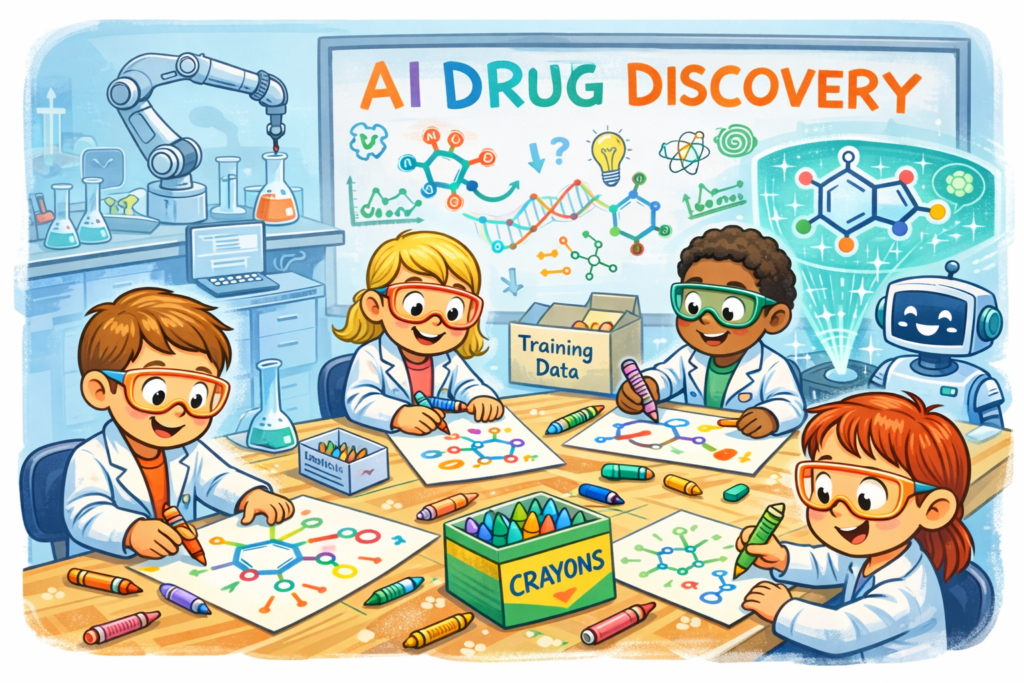
Suppose a medicinal chemist’s child draws a random figure with a crayon.
The chemist sees this scribble and it sparks an idea for a new drug candidate, which is then synthesized, tested, and eventually patented.
Is the child the inventor?
Of course not.
The child had no conception of the invention and no understanding of the problem being solved.
It was the chemist who made the connection between the scribble and the SMILES, and who then developed it into a workable solution as the inventor.
But unlike the child’s random scribble, modern AI platforms are often trained on disease-specific multiomics data and are explicitly generating candidates to solve particular therapeutic problems.
When an AI system analyzes genomic data, protein structures, and clinical outcomes to design a molecule targeting a specific disease pathway, is that fundamentally different from a human medicinal chemist doing the same analysis?
The AI may be operating within a disease context, suggesting solutions to clinical problems which could be argued as an inventive step rather than mere data processing.
So, to repeat, who (or what) was the inventor?
This ambiguity isn’t settled law, and that creates both risk and valuation uncertainties.
As legal experts note, disputes over inventorship can arise when AI generates compounds that are then synthesized and tested.
If the AI company claims inventorship based on the platform’s disease-contextualized computational design, but the pharma partner argues their scientists’ work was the true inventive step, the resulting IP dispute can cloud patent rights and diminish asset value.
These concerns can emerge in licensing negotiations because unclear inventorship creates risks around patent validity, freedom to operate, and the scope of licensed rights…and that is before we get into sublicensing and related issues, where there are multiple parties with a call on candidate value (we’ll leave that particular can of worms unopened).
The challenge extends beyond just inventorship to ownership of the underlying data and models.
Licensing counsel must consider who owns the training data used to generate candidates, who owns improvements to the AI model that result from the collaboration, and who controls regulatory data packages.
These questions matter because they determine what rights are actually being licensed and what value is being transferred back to the Licensor.
Yeesh.
The practical impact on deal structure is also significant.
Many AI licensing agreements should include detailed provisions specifying how inventorship will be determined, how improvements to AI models will be handled, and how regulatory data ownership will be allocated.
Some deals build in joint invention frameworks where both parties share rights to AI-generated compounds, while others use work-for-hire / service provider structures to clearly assign ownership.
The lack of clear regulatory and legal frameworks creates uncertainty that Licensees can address by demanding lower upfront payments, more extensive due diligence on IP chain of title, and/or indemnification provisions covering inventorship challenges.
For BD&L teams, this means AI asset valuations must account for IP risk in ways that traditional discovery assets simply don’t require.
In fact, one can argue that a computationally-designed molecule with ambiguous inventorship may warrant a valuation discount compared to a traditionally-discovered molecule with clear patent rights, even if the clinical profile is identical.
Until legal frameworks mature and case law develops around AI inventorship, this IP ambiguity will remain a challenge on AI asset valuations in licensing negotiations.
Key Takeaways
- AI inventorship is legally ambiguous because patent law wasn’t designed for computational discovery systems operating in disease-specific contexts
- Disputes over whether the AI platform, pharma partner, data scientists, or medicinal chemists are the true inventors can cloud patent rights and reduce asset value
- Licensing agreements increasingly include detailed provisions on inventorship determination, model improvement ownership, and regulatory data control
- AI-discovered candidates with unclear inventorship may warrant valuation discounts versus traditionally-discovered molecules with clear IP, regardless of clinical profile
Coming Up in Part III: Quantifying the AI Contribution
Even if IP ownership is clearly established, a problem remains: how do you quantify what portion of a candidate’s value should be attributed to AI discovery versus traditional development work?
In Part III, we’ll examine how the industry is structuring deals to separate computational value from downstream development contributions, and what metrics actually matter in determining fair compensation.
NB: LLMs were used for some of the research aspects of this post.