From Pyramid to T, Part 3: What the T-Shaped Organization Means for BD Professionals
Using ADP payroll data covering millions of US workers, researchers at Stanford found that employment of 22- to 25-year-olds in the most AI-exposed occupations is now about 19% below where it would be had it kept pace with their less-exposed peers.
More experienced workers in the same occupations show no comparable gap. And the change is coming mainly through fewer young hires, not layoffs (Brynjolfsson, Chandar, & Chen, 2026).
That’s the base of the pyramid getting narrower.
Every conference panel and YouTuber says the same thing; learn AI.
And while it may be true, it’s also about as useful as telling a B-school student to learn Excel.
In Parts 1 and 2, I argued that the BD org chart is moving from a pyramid to a T, and looked at what it takes to build one well.
The obvious next question is a personal one.
If you work in BD today, where do you fit?
The T-Shaped Person, Revisited
“T-shaped” originally described a person, not an organization. McKinsey reportedly used the term internally in the 1980s, and IDEO’s Tim Brown later championed it. The idea is that the stem represents deep expertise in one field, and the crossbar is the ability to work across many disciplines (Wikipedia, n.d.).
I would argue that the crossbar of a T-shaped BD organization is made of T-shaped people.
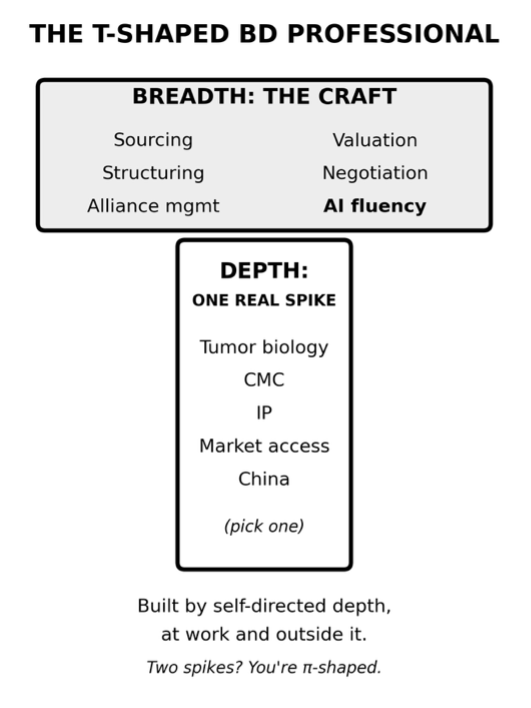
Their personal crossbar is expertise in many (but not all, and this is critical) aspects of our craft: sourcing, valuation, structuring, negotiation, alliance management, and yes, AI fluency. Their stem is one real spike of depth, such as tumor biology, CMC, IP, market access, or China. Some have two, which makes them π-shaped rather than T-shaped.
Regarding the expertise point, it is foolish to expect every member of the crossbar to have experience or be good at everything. That is what makes a team; not a collection of equals, but a group with a diverse set of skills and experiences that can collaborate with each other and are extremely AI fluent.
Given that they are also T-shaped people, they are probably some of the most interesting people in the entire enterprise.
How do you spot them?
With careful reading of a résumé or a LinkedIn profile. The scientific credentials are there, as is the demonstration of AI fluency. But what you’re really looking for is evidence of self-directed depth.
Sometimes it shows up at work. It is the analyst who built a screening workflow nobody asked for. It is the manager who published a competitive landscape framework that the whole company now uses. It is the director who taught an internal session on something outside their job description, and now runs that same session across multiple locations within the company.
Sometimes it shows up outside work, and those signals count too.
We’re not talking about someone who “enjoys running,” but someone who coaches a running club and used Claude to build the training-plan tool for it. It’s not “reads fiction,” but someone who restores old Porsche 911s (and only 911s), or has taught themselves Mandarin using an LLM, or is building an online coffee mug and t-shirt business with their kids. Often, you’ll find AI fluency there as well, picked up on their own time, for their own reasons, at their own expense.
That habit of going deep without being told to is what builds a spike, and it’s the best predictor I know of who will build the next one. They already know how to “spike” with AI when needed.
Treat the personal examples as signals, not requirements.
I recognize that not everyone has the free time for this. A single parent balancing a BD career and young kids may have nothing on that part of their LinkedIn profile.
Its absence proves nothing. But its presence tells you a lot.
The Harvard/BCG study makes the point. Consultants using GPT-4 improved across the board, but below-average performers improved by 43%, while top performers improved by 17% (Bastian, 2023; Dell’Acqua et al., 2026). In other words, AI levels the baseline. And when the baseline is levelled, the premium moves to whatever AI doesn’t level, i.e., having the gumption to teach yourself Mandarin. Or, as I put it to the participants in a recent course…your domain expertise is the multiplier (Velez, 2026b).
Who’s Exposed, Rung by Rung
Analysts and associates. These folks are arguably the most exposed. The competitive landscapes and first-pass models that defined the role are exactly what AI does well. In most groups the rung won’t vanish, but it will shrink. The time spent shifts from producing analysis to checking it. Is a company going to be willing to pay someone to check the AI? Or, will that salary be spent on more senior people who will be checkers and the producers and the decision makers? But what happens when the junior checker is so AI fluent that their skills exceed those of their boss?
Managers and associate directors. They may be the squeezed middle. Much of the job has been coordinating analysts and their analyses. That coordination is now partly automated. The way out is up onto the crossbar, or down into deep expertise. Choose wisely,
Directors and VPs. They have lower exposure because they have the grey hairs, but they are vulnerable if they refuse to become highly AI-fluent. Negotiation, deal structuring, internal consensus and relationships are human work. But a VP who cannot use AI to interrogate an AI-generated rNPV, or who cannot build a skill on the fly while waiting for the coffee to finish dispensing, will be outpaced by the one who can.
Heads of BD. They own the transition, and they’ll be judged on whether they designed the T or just let it happen. If their skill set involves navigating internal politics and egos to get things done, then their lack of AI fluency may be irrelevant (at least in the short term).
Independents and fractional professionals. They have a tremendous opportunity, if they feel comfortable with setting up their own mini-consultancies and marketing themselves and their skills. Fractional executive roles are already normal in biotech (Thacker, 2025). The T makes specialists more valuable, not less, provided that independent specialists can operate at the pace of AI. The T creates demand for on-call experts, both within the stems and even in the crossbar. Indeed, advisors to the crossbar can provide both depth and occasional capacity when needed. But they must be AI fluent. Paradoxically, independent professionals will be expected to be AI fluent and thereby expected to deliver greater insights in shorter period of time. Those three-month engagements will be expected in one month (and possibly at a lower fee).
Five Capabilities Beyond “Learn AI”
OK. We all must “learn AI.” But what does that mean exactly? Are we all learning Python? I hope not.
Taking some courses to understand the basics is important. But beyond that, it gets complicated because these capabilities are not easily taught via a series of hour-long videos.
I teach a one-day course on AI in BD&L, and my parting slide tries to answer exactly this question (Velez, 2026b). In my view, the AI-fluent BD professional:
- defines the problem before choosing the tool;
- creates reusable specs and workflows;
- distinguishes facts, claims, estimates, assumptions, and unknowns;
- verifies before outputs travel;
- integrates findings into actual BD decisions, using judgment and taste;
- knows when to override the model, and documents the override.
Notice that none of these is about which model or which tool to use. They’re about BD judgment. Here are the five capabilities underneath them.
1. Judgment on the jagged frontier. AI is brilliant at some tasks and quietly wrong on similar-looking ones. Researchers call this the “jagged technological frontier.” In the same BCG study, consultants using AI on a task just outside that frontier were 19% less likely to reach the right answer than those working without it (Martinez & Mezitis, 2023).
They trusted confident output.
In Death by PowerPoint, the AI Edition, I quoted a line that has stuck with me: the good-looking failures are the dangerous ones (Brosse, 2025). Knowing where the frontier sits for BD work, and checking the output accordingly, is a skill.
It’s arguably the skill.
In BD, the frontier shows up in familiar places, like a summary that reports overall response rate when the licensee cares about complete response, or a patent landscape that misses a continuation, or a competitor table built from a press release rather than the clinical trial registry.
None of these errors announce themselves.
You read something and it doesn’t feel quite right.
You catch them only if you know the domain well enough to be suspicious.
And when you do override the model, write down why, both in the deliverable and in the instructions you give the AI, so the next run doesn’t repeat the mistake. The rule I give my course participants is a simple one: materiality should increase human involvement, not AI autonomy.
2. Framing the question. A deep dive is only as good as the question it answers. Is this asset differentiated against the three compounds that will read out before this one does? What would the licensee’s own rNPV have to assume to justify our upfront? HBR calls the person who does this the “engagement architect” (Duncan et al., 2025).
To put this another way. A bad question eloquently answered at machine speed is still a bad question.
3. Owning the expert bench. The stem of the T only works if you can reach the right CMC or regulatory expert this week, not next quarter. In a T-shaped organization, your network of trusted specialists becomes a personal professional asset, not a line on someone else’s org chart.
That means investing in relationships long before you need them. You already have them if you’re an active networker. In the pyramid, those relationships belonged to the company. In the T, they increasingly belong to you, because many of them may sit outside of the enterprise. You will be expected to make the decision to pull in external expertise quickly, because everything else is now happening quickly.
Hopefully the experts are available when you need them, and hopefully you have the budget to compensate them based on domain expertise and speed of response.
4. The human work. Licensors partner with people they trust. Internal champions have to be persuaded in a room, not through an LLM. Even Klarna, which went further than most in replacing people with AI, concluded that customers need to know a human is there when it matters (Shibu, 2025).
BD is no different.
5. Directing agents, not just using tools. Microsoft describes the emerging role of the “agent boss” as someone who builds, delegates to, and manages AI agents (Microsoft, 2025). For BD, that means designing (and sharing) your own workflows, deciding what the AI does before a human looks, and reviewing its work the way you’d review a more junior-level analyst’s work.
I would also add one more factor that is quite challenging for folks outside of the computer science / IT world. And that is trying to keep up with the latest changes in LLMs, their capabilities, their flaws, and their risks.
Vendor documentation is the best starting point on what the tools can do, and it’s free and easily accessed. However, treat their claims about value the way you’d treat any company’s press release. Beyond that, some caution and discernment are prudent.
What to Do, by Career Stage
Early career. I believe it is still necessary to enter the T through domain expertise, not as a generic analyst. But having a PhD and an MBA may not be enough for the T-shaped organization of the future. Demonstration of AI fluency in areas of science, competitive intelligence, IP, or another domain will be an important part of the job-seeking and hiring process.
But what about the No Job / No Experience problem?
There is no easy solution, but you can still do something to demonstrate some AI diligence skills. For example, pick a few drug candidates and perform AI-based due diligence, using only public information, to the extent you can.
Spin up a temporary website to house your analysis, then share the link with the prospective employer. Any decent LLM can create a web site with a shareable link in minutes. Put this on your LinkedIn profile and your eMail signature.
Don’t know how to spin up a website? Not a problem. Have the LLM do it for you.
Demonstrate that you are the person who can build and oversee the stem of the T.
Demonstrate that you can use LLMs in useful and creative ways to get things done, with speed, accuracy, and insight.
That’s the new apprenticeship. Call it self-apprenticeship, if you will.
During the initial months of employment, study past diligence projects to gain fluency in how the team uses AI, and suggest changes and improvements to skills, agents, and workflows.
Expect some long hours as part of this process.
Mid-career. Either climb into the crossbar (via relationships, negotiation, or internal influence) or go deep enough in one area that the crossbar calls you when it matters. Staying in the middle of the pyramid is the riskiest option, especially if it is morphing into an hourglass.
Either way, make your choice visible. Lead a pilot of AI-assisted triage in your group. Collaborate with colleagues on developing new skills for the team. Publish an AI-based competitive landscape analysis on an internal wiki. Teach a session internally.
The people who can design the stem are the ones who get chosen for the crossbar.
Senior. As of this writing, we are entering the fourth quarter of 2026. Adoption across BD is still uneven, but for ambitious BD professionals, AI fluency is becoming the new table stakes. Having multiple post-baccalaureate degrees and years of experience is not enough anymore. Your job now includes the migration from the pyramid to the T, as well as training the people who will replace you on the crossbar.
To put this another way, corporate politics can buy a department head some time, but it won’t buy them a second act.
Independent. Fractional executive roles are already normal in biotech (Thacker, 2025). The T makes specialists more valuable, not less, provided that independent specialists can operate at the pace of AI.
Where I’ve Landed
- “Learn AI” is the floor, not the ceiling. Remaining grounded to the floor is no longer an option.
- Get a spike. A generalist without depth competes with the machine or someone who is more AI fluent.
- Learn where AI is wrong. Verification, executed by both humans and AI, is a huge part of this craft.
- Build your bench. Your network of experts is part of your value.
- Design the apprenticeship. The base of the pyramid used to do that for free. Now you may have to design and execute your own apprenticeship, and market it accordingly.
References
Bastian, M. (2023, September 25). GPT-4 could be the great skill leveler for consultants, study shows. The Decoder. https://the-decoder.com/gpt-4-could-be-the-great-skill-leveler-for-consultants/
Brosse, N. (2025, February 18). PDF parsing for LLM input. Nicolas’ Notebook. https://nbrosse.github.io/posts/pdf-parsing/pdf-parsing.html
Brynjolfsson, E., Chandar, B., & Chen, R. (2026). Canaries in the coal mine? Six facts about the recent employment effects of artificial intelligence (Revised August 12, 2026; original work published 2025). Stanford Digital Economy Lab. https://digitaleconomy.stanford.edu/publications/canaries-in-the-coal-mine/
Dell’Acqua, F., McFowland, E., Mollick, E., et al. (2026, March 11). Navigating the jagged technological frontier: Field experimental evidence of the effects of artificial intelligence on knowledge worker productivity and quality. Organization Science, Articles in Advance, pp. 1–21 https://www.hbs.edu/ris/Publication%20Files/dell-acqua-et-al-2026-navigating-the-jagged-technological-frontier_5c589c8c-fbb5-458f-b285-c944746cd717.pdf
Duncan, D. S., Anderson, T., & Saviano, J. (2025, September 10). AI is changing the structure of consulting firms. Harvard Business Review. https://hbr.org/2025/09/ai-is-changing-the-structure-of-consulting-firms
Martinez, C. J., & Mezitis, T. A. (2023, October 13). Harvard Business School partners with BCG on AI productivity study. The Harvard Crimson. https://www.thecrimson.com/article/2023/10/13/jagged-edge-ai-bcg/
Microsoft. (2025, April 24). The 2025 annual Work Trend Index: The Frontier Firm is born. https://news.microsoft.com/source/asia/2025/04/24/the-2025-annual-work-trend-index-the-frontier-firm-is-born/
Shibu, S. (2025, May 9). Klarna is hiring customer service agents after AI couldn’t cut it on calls, according to the company’s CEO. Entrepreneur. https://www.entrepreneur.com/business-news/klarna-ceo-reverses-course-by-hiring-more-humans-not-ai/491396
Thacker, M. (2025, June). How to successfully scale your biotech (from someone who’s done it). Montrium. https://blog.montrium.com/blog/how-to-successfully-scale-your-biotech-from-someone-whos-done-it
Velez, C. N. (2026a, September 21). Death by PowerPoint, the AI edition. Lacerta Bio. https://lacertabio.com/death-by-powerpoint-the-ai-edition/
Velez, C. N. (2026b, September 29). AI for pharma BD & licensing [One-day course]. CELforPharma. https://www.celforpharma.com/course/ai-pharma-business-development-licensing-course
Wikipedia. (n.d.). T-shaped skills. https://en.wikipedia.org/wiki/T-shaped_skills