From Pyramid to T, Part 1: Why AI Is Reshaping the Business Development Organization
Every BD&L course I teach has, at some point, at least one participant bring up the BD org chart.
You know the one. Head of BD at the top. A couple of VPs. A row of directors. A wider row of managers. And at the bottom, the widest row of all: the analysts and associates.
It’s a military-style pyramid that evolved to maintain communications up and down the chain of command. It’s the same pyramid that has been used in the business world for well over a century. It has been a pyramid for as long as we have been in this business.
And its base is starting to shrink.
Why the Pyramid Exists
The pyramid isn’t an accident. It’s a staffing answer to a volume problem.
In Widening the Funnel, I used AbbVie’s disclosed numbers: roughly 2,000 inbound partnering opportunities a year, narrowing to about 15 executed deals. Somebody has to read the 2,000 decks.
That somebody usually sits at the bottom of the pyramid. They are the ones preparing the competitive landscapes, performing the first-pass screens, the first rNPV calculations, the data room triage, etc. Upstairs, the directors and VPs review the results, build the relationships, lead the negotiations, and do the hardest job in BD, which is building internal consensus.
You can see the structure in almost any large pharma job posting. A 2024 Novartis posting for a Director of Search & Evaluation describes a role working closely with disease-area leads and convening research, CMC, safety, regulatory, commercial, legal, patents and finance for every evaluation (Novartis, 2024). Entry-level Associate Manager roles are pitched as the doorway into all of it.
David Maister called this leverage in terms of matching the complexity of a task to the cost of the person doing it (Maister, 1993). But it’s also an apprenticeship. The analyst who assesses fifty opportunities learns what a good asset looks like. That’s how you make a director. Both jobs matter.
Hold that thought. I’ll come back to it.
AI Can Now Do Much of the Base’s Production Work
Much of the work at the bottom of the pyramid is exactly the work AI is best at.
Think about what fills an analyst’s week. Reading publications and patents. Pulling data out of a data room. Building a competitive landscape. Populating the first version of an rNPV model. Summarizing all of it into an evaluation deck.
It’s text- and data-heavy, structured, repetitive, and the sweet spot for a large language model.
To be clear, that’s the production work, not the whole job. Good analysts also notice oddities, triangulate weak signals, pressure-test a senior colleague’s enthusiasm, chase missing context, and slowly absorb the company’s strategic tastes. AI doesn’t do that part well. But the production work is what fills the hours, and the hours are what justify the headcount.
This is no longer hypothetical. At the 2026 Swiss Biotech Day, a panel on AI in partnering and finance noted that large pharma no longer treats AI as an experimental add-on in BD. As an example, panelists pointed to AI support for managing data room content during diligence and for modelling and valuation work (Gutzwiller & Meier, 2026).
Startups are leaning into this trend and building products to meet the demand. For example, Convexia, a young Y Combinator company, uses AI agents for sourcing, scientific evaluation, commercial analysis and clinical risk assessment of drug assets (Y Combinator, n.d.). Personally, I would treat its productivity claims with the usual skepticism, but the direction is clear.
And the other side of the table is changing too. As I wrote in Death by PowerPoint, the AI Edition, the first “reader” of your out-licensing deck is increasingly an LLM, not the VP of BD. Similarly, in Widening the Funnel, I argued that AI lowers the cost of each CDA. If this is true, and if AI performs the first pass on every opportunity, what is the pyramid actually for?
And that’s a question other industries have already tried to answer.
Everyone Else Is Already Redrawing the Chart
Biopharma BD is not the first profession to face this challenge.
Consulting. In Harvard Business Review, Duncan, Anderson and Saviano (2025) argue the consulting pyramid is becoming an obelisk: fewer layers, smaller teams, and three roles: AI facilitators, engagement architects, and client leaders. McKinsey’s internal AI tool is reportedly used by about 72% of its staff and has cut research and synthesis time by roughly 30% (Consulting.us, 2025).
Not everyone is buying into the obelisk concept. Two other shapes are on the table.
The hourglass keeps the top and the bottom and squeezes the middle. Juniors run the AI, partners keep the clients, and the manager layer that used to coordinate the work shrinks (Cuofano, 2025). Note that this is exactly what happened when industries moved from paper to digital communications. Many of the paper pushers were replaced by bits and bytes.
McKinsey appears to be making an interesting bet on the bottom half of that hourglass. In late 2025 it announced plans to grow its North American headcount by 12% in 2026. Its North America chair argued that young hires are more fluent with the new tools than the veterans are (People Matters, 2025). This suggests that McKinsey is looking to increase their production capacity, and link it directly to senior folks contributing both insights and client relationships. But as the upper section of the hourglass becomes more AI fluent, could the upper section of the hourglass narrow as a result? Interesting question.
The box narrows the gap between senior and junior altogether. Antonio Alvarez, head of Alvarez & Marsal in Europe, has argued for a model in which senior headcount sits much closer to junior headcount, relying on experienced professionals rather than a large pool of analysts. He also expects AI to increase overall demand for his firm’s services, presumably due to the faster rate of production deeply linked to senior-level insight (Deep News, 2025).
Obelisk, hourglass, box…three shapes with one shared conclusion: the wide base is no longer the default.
Law. Firms are debating a diamond (thinner base, fatter middle, thinner top), a rectangle, and (my personal favorite), the “rocket“, which refers to lawyers flanked by technical staff (Cocker, 2020).
Investment banking. By mid-2026, the conversation moved from “weighing” cuts to making them. According to a McKinsey partner quoted by Bloomberg, banks are cutting junior analyst classes by as much as two-thirds. Goldman Sachs’ president described parts of the bank as a “human assembly line” ripe for automation, and JPMorgan’s Jamie Dimon said plainly that AI “will eliminate jobs.” But not everyone is retreating. Bank of America kept its class of 2,000 full-time recruits, while aiming to hold overall headcount flat (Short & Bloomberg, 2026).
What strikes me is that nobody is defending the pyramid. They only disagree about what replaces it. Nobody looks at AI and says, “We should organize ourselves as a pyramid.”
So which model is most suited for biopharma BD? The hourglass? The diamond? The rocket?
My bet for BD is none of the above.
It’s a T.
The T-Shaped BD Organization
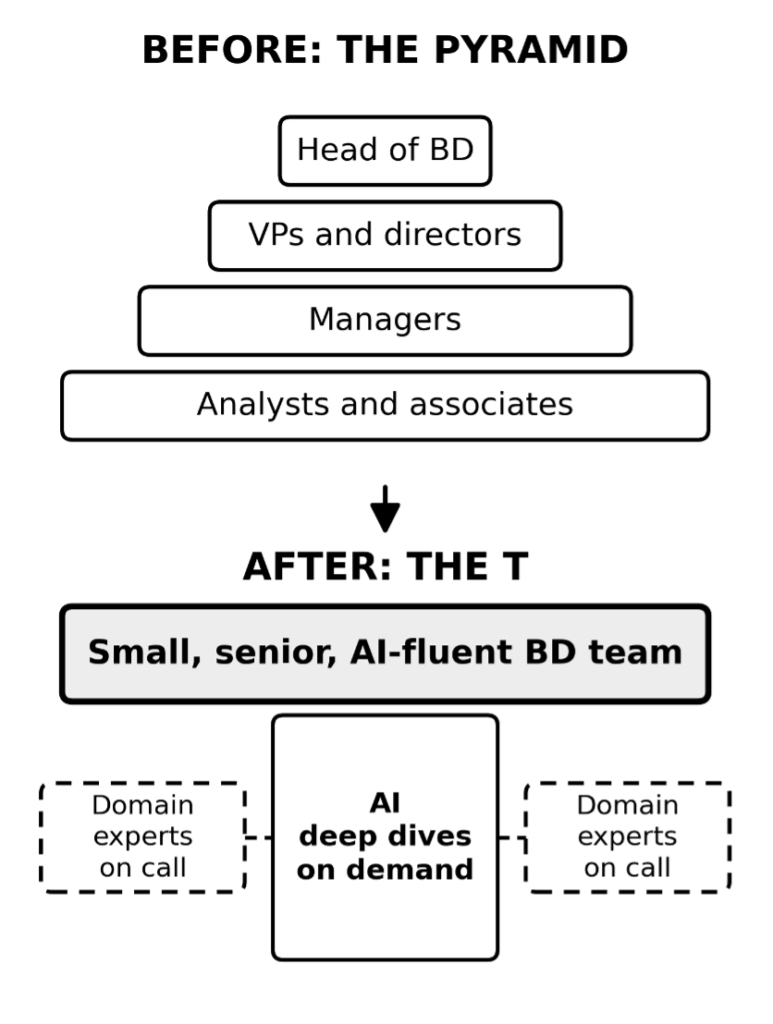
The T-shaped organizational chart has two basic components: the crossbar and the stem.
The crossbar is a small, tight team of experienced, AI-fluent BD professionals (note the emphasis). They set the criteria, frame the questions, source, negotiate, and build internal consensus. They own the relationships, and they own the decisions.
And they use AI themselves, and they do so constantly. They don’t delegate it to someone two floors down. They use it across their entire workflow, from initial diligence to negotiation prep. This team has a collection of skills, agents, and other AI tools (many of which are custom built) to make their work more efficient, more thorough, and just plain better.
The stem is depth on demand. AI does the deep dive when diligence requires it and where AI can do so, i.e., an initial IP landscape, competitor mapping, the rNPV first pass, the adjacency analysis, and so forth.
When a question outruns the machine, domain experts are called in, such as CMC, IP counsel, regulatory, clinical, and market access, for that deal. Some domain experts are internal, some are not.
And, by the way, the domain experts (especially the external ones) are also AI-fluent. They’re delivering on their domain expertise at unprecedented speed, scale, and accuracy. They also have custom-built AI specs, workflows, skills, etc. They don’t deliver their deep domain-level expertise in 4 weeks. They do it in four days without missing a single coffee break or weekly round of golf.
The AI-fluent external domain experts have two huge potential advantages over internal experts. First, they are not hamstrung by restrictive IT and security policies. They can theoretically use whatever models and skills and workflows that work best for them, with the caveat that they are not sharing deeply confidential information to the bots for training purposes. Speed and tool freedom is part of their advantage, assuming, of course, that the external domain expert is working within CDA guardrails.
Second, they have already built their workflows and refined and improved them across many clients and many projects. Their next client benefits dramatically from what other clients have paid for. It all compounds.
But why a T, and not an obelisk or a diamond?
I think there are two reasons BD&L may go much further than law or consulting.
First, and let’s be blunt about this, BD&L is a cost center. Law firms and consultancies protect their base partly because juniors are billable. Nobody bills a licensing analyst’s hours. The BD team demonstrates value through sourcing, evaluating, and transacting on opportunities that are a strategic fit for the company, but at a pace and scale that is superior to their competitors. If the T can reduce the cost, it will be implemented.
Second, the experts were never really on the BD org chart. Look at that Novartis posting again. Every evaluation already pulls in half a dozen functions from outside BD. The greatest challenge for that employee will be figuring out who to call within the Novartis org chart to provide feedback on an opportunity. In a very large organization, that is a very challenging exercise. The T just makes this reality honest.
What the T Does Not Mean
Before going further, let me be clear about what I’m not saying.
- AI does not eliminate BD judgment. It moves it, from producing the analysis to deciding which analysis to trust. Note I keep using the word production here.
- AI does not replace domain experts. The stem is AI plus people. If anything, the experts matter more, because they catch what the machine gets wrong.
- AI does not make every analyst redundant. In very large pharma and high-volume licensing groups, the base may shrink, change, or become more technical rather than disappear. Some firms will keep junior classes on purpose.
- AI does not remove the need for apprenticeship. It removes the accidental apprenticeship. The deliberate one still must be built.
I’ve Drawn This Shape Before Without Realizing It
I’ve been unwittingly sketching this T for years without calling it that.
In a 2021 whitepaper (an eternity in the AI context) for ShareVault on building a BD&L strategy, I argued that companies should not outsource the entire BD&L effort, but that major portions of it can be outsourced. I suggested that keeping a small internal function focused on its core competence maintains flexibility. Overseeing external staff then becomes part of the job (Velez, 2021).
I recommended outsourcing the labor-intensive work, and my example was mapping every indication adjacency for a broad mechanism like anti-TNF, so it could run in parallel. I recommended local consultants to extend geographic reach. And I argued that preclinical, clinical, CMC and regulatory colleagues should be feeding opportunities to BD.
- Small internal core.
- Outsourced depth.
- Experts pulled in from across the value chain.
That’s a pre-AI T.
There was one flaw in my proposed model. In 2021, the stem was consultants, and consultants are expensive, so companies used them sparingly.
What changed in 2026 is the cost and speed of the stem.
The Apprenticeship Cliff
This brings me back to the thought I asked you to hold earlier.
BD’s leverage model also trained its future leaders. But AI replaces the leverage model with something that runs 24/7/365 for a tiny fraction of the cost. Economically, it makes sense. But the real strategic risk is losing the apprenticeship along with it and not noticing until the day you need to promote someone to replace someone that is leaving and you do not have an internal candidate that is ready.
That cliff is the subject of the rest of this series. In Part 2, we’ll look at how a BD group actually gets from pyramid to T without breaking what works. In Part 3, we discuss what it all means for the people inside it.
References
Cocker, C. (2020, June 30). Deconstructing the pyramid. Society for Computers and Law. https://bytes.scl.org/deconstructing-the-pyramid/
Consulting.us. (2025, September 29). How AI is revolutionizing consulting firm structure. https://www.consulting.us/news/12442/how-ai-is-revolutionizing-consulting-firm-structure
Cuofano, G. (2025, December 13). Three competing models for the future of consulting: Obelisk, hourglass, or box? FourWeekMBA. https://fourweekmba.com/three-competing-models-for-the-future-of-consulting-obelisk-hourglass-or-box/
Deep News. (2025, December 2). AI enables “extracting more value from fewer junior staff”: McKinsey and other consulting giants freeze starting salaries for third consecutive year. Tiger Brokers. https://www-web.itiger.com/news/1135883589
Duncan, D. S., Anderson, T., & Saviano, J. (2025, September 10). AI is changing the structure of consulting firms. Harvard Business Review. https://hbr.org/2025/09/ai-is-changing-the-structure-of-consulting-firms
Gutzwiller, P., & Meier, T. (2026, May 11). AI in pharma/biotech fundraising, partnering and finance. GoingPublic. https://www.goingpublic.de/life-sciences/ai-in-pharma-biotech-fundraising-partnering-and-finance/
Maister, D. H. (1993). Managing the professional service firm. Free Press.
Novartis. (2024, November 18). Director, Search & Evaluation (REQ-10027756) [Job posting]. https://jobapi.novartis.com/node/321786/printable/print
People Matters. (2025, September 12). McKinsey rejects AI job fears, to boost hiring by 12% in 2026. https://www.peoplematters.in/news/strategic-hr/mckinsey-rejects-ai-job-fears-to-boost-hiring-by-12percent-in-2026-43536
Short, M., & Bloomberg. (2026, June 7). Banks lay groundwork for mass workforce cuts as AI takes hold. Fortune. https://fortune.com/2026/06/07/banks-mass-workforce-cuts-ai-entry-level-jobs-junior-analysts/
Velez, C. N. (2021, December). Building a successful business development & licensing strategy [Whitepaper]. ShareVault. https://www.sharevault.com/whitepapers/building-a-successful-business-development-and-licensing-strategy
Velez, C. N. (2026, September 8). Widening the funnel: How AI changes the math of in-licensing, Part A. Lacerta Bio. https://lacertabio.com/widening-the-funnel/
Velez, C. N. (2026, September 21). Death by PowerPoint, the AI edition. Lacerta Bio. https://lacertabio.com/death-by-powerpoint-the-ai-edition/
Y Combinator. (n.d.). Convexia [Company profile]. https://ycombinator.com/companies/convexia