From Pyramid to T, Part 2: How to Get There, and What Has to Be True
In Part 1, I argued that the BD org chart is moving from a pyramid to a T: a small, senior, AI-fluent team across the top, with AI and on-call domain experts providing depth underneath.
Drawing the T is the easy part. This post is about the much harder subject of the route from here to there, and the four things that have to be true for the T to work.
How Do You Get There?
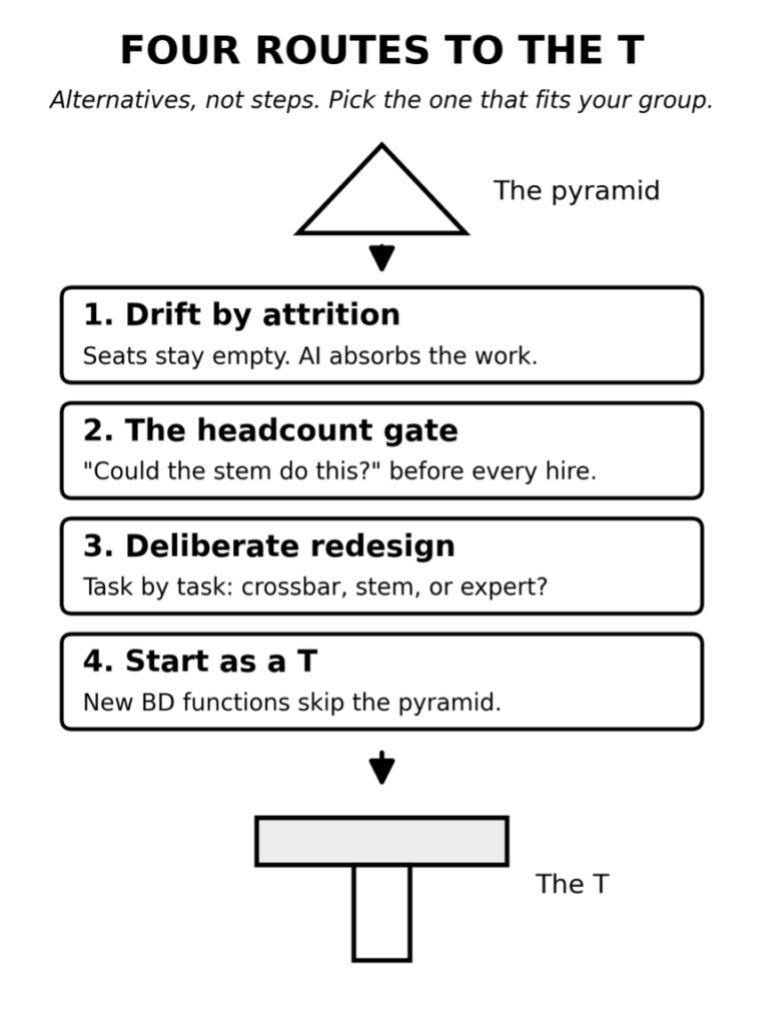
Nobody wakes up one morning and suddenly shifts from a pyramid-shaped to a T-shaped org chart. I can think of at least four routes. There may be more.
Drift by attrition. An analyst leaves, and the seat remains vacant. Thanks to AI, the rest of the shrinking team quietly absorbs the work. This is the most common path, because it requires no decision at all.
Take Klarna as an example. This is a Swedish fintech company best known for its “buy now, pay later” payment service, used by millions of online shoppers and which handles millions of customer inquiries a year. It froze hiring in December 2023. As a result, over the next year its headcount fell about 22%, to roughly 3,500, mostly through attrition. But, it started hiring humans again for customer service, once its CEO admitted quality had suffered (Shibu, 2025).
You can replace some humans with chat bots, but not all.
The lesson for BD is an important one. When you shrink by attrition, the shape is set by who happens to leave, not by design. You might lose your best mid-level evaluator and not notice the gap until a deal goes sideways, and nobody is there to build the skills and agents to perform the work once performed by the departed.
The headcount gate. In 2025, Shopify’s CEO told his teams that before asking for more headcount, they had to show why AI couldn’t do the job (Nolan, 2025). If I were running that gate, I would send every headcount request to an LLM, and ask it to build the workflow or skill that would do that job. If this happens, then headcount requests are being used to expand the skills of their AI infrastructure, which is far cheaper and faster than hiring.
The BD version works the same way. Every new requisition comes with a question. “Could the stem of the T do this?” Can we build a workflow that does this in lieu of the new hire?
Deliberate redesign. Take the BD workflow (search and evaluation, diligence, transactions, alliance management) and go task by task. Does this task belong in the crossbar, down a stem, or in the hands of a human expert?
Do we let people go as part of this process? Perhaps.
If so, it may be prudent to reinvest the savings into tools and experts on retainers. Microsoft calls this moving from an org chart to a “work chart” and managing a “human-agent ratio” (Microsoft, 2025). It is both the hardest route and arguably the best route because it is purposefully designed, but it will come with some pain.
Start as a T. A new BD function, whether a spin-out, a NewCo, a biotech making its first BD hire, or a venture studio, has no legacy pyramid to unwind. Under this unusual scenario, the best approach may be to simply start with a crossbar of one or two people and build the stem from day one. Biotech is already comfortable with fractional executives. To put some numbers on it, fractional C-suite hires can save biotechs 25% to 40% of the cost of a full-time executive (Fischer, 2024). But the risk is the bench. Everything rests on one or two people, and nobody is learning behind them.
The same logic applies on the sell side. Many Licensors out-licensing an asset have a BD team of one, and that person is already a crossbar without a pyramid. AI and a trusted bench of experts give them the stem: data room preparation, partner screening, and valuation support that once required a banker or a team of consultants. This assumes that one-man band is AI-fluent, and that is not always the case (I know. I see their out-licensing decks…).
My view is that most established BD groups are already moving toward the T, whether anyone has decided to do it.
So the real choice is somewhere between drift and design, with headcount gating built into hiring policy and practice.
If I were running a BD group today, I’d freeze the base, pilot the stem of the T on one workstream (inbound triage and competitive landscaping are the obvious candidates), measure evaluations per head and the quality of the “no” decisions, and only then decide on backfills.
Whichever route you take, four conditions decide whether the T works or just looks good on a slide.
1. Separate Production Work from Accountability Work
AI can produce the first-pass landscape, the rNPV draft, the patent summary, the deck review. That’s production.
Someone still owns the consequences of being wrong. Someone recommends the deal to the portfolio committee, signs off on the peak-sales assumption, defends the valuation when the CFO pushes back, and answers for it two years later when the Phase 2 data disappoint. That’s accountability work.
Accountability isn’t just checking the AI’s output, and this is commonly misunderstood when it comes to discussions surrounding AI output. It’s judgment under uncertainty, persuading the organization, and owning the risk.
The stem produces and checks, while the crossbar owns.
The practical rule I give in my AI course is as follows: every AI workflow ends with a named decision owner (Velez, 2026). If nobody’s name is on it, nobody owns it, and the machine’s confident first draft quietly becomes the company’s position.
This is not what you want.
2. Govern the Stem
BD runs on information other people trusted you with, such as counterparty data supplied under CDAs, unpublished clinical results, material non-public information when the other side is listed, or even the details behind your own company’s strategy.
Pasting a partner’s data room into a consumer chatbot isn’t a productivity hack. It may breach the CDA you just signed. Ask your corporate counsel about this and go by their policies, not what you’re reading in this post.
So, a real BD stem can’t just be Claude and a few consultants. It needs:
- Approved tools, licensed at the enterprise level, with clear terms on how data is used and retained. There should be clear policies against the use of personal AI accounts for work-related matters. However, expect a mild uprising when team members complain that they cannot do things on their work laptop which they can clearly do on their personal mobile.
- Audit trails of what was asked and what came back.
- Source traceability, so every claim in an AI-generated summary links back to a document someone can check.
- Clear rules on what may leave the company, and what may never be uploaded at all.
None of this is a reason to slow down. It’s a reason to treat the stem as an organizational design problem, not a software purchase. Gartner predicts that over 40% of agentic AI projects will be canceled by the end of 2027, citing escalating costs, unclear business value, and inadequate risk controls (Gartner, 2025). Governance is how you stay out of that 40%.
3. Give the Expert Bench a Reason to Show Up
Why would your CMC lead drop her own priorities to answer BD’s 48-hour diligence request?
This question has always existed. But just because AI-fluent BD teams are operating at newly found speed, it does not mean that everyone else across the organization is operating at the same pace. “Calendars gonna calendar” as a young person might say (or not).
On call is not the same as available. Internal experts who aren’t staffed to BD will help when they can, which may not be when you need them. Without capacity and incentives, the stem becomes a queue, and the T’s speed advantage disappears.
The fixes are not exotic:
- Protected capacity. A small, agreed share of key experts’ time is set aside for BD diligence each quarter.
- Recognition. Diligence support appears in their objectives and reviews, not just as a favor.
- Agreed turnaround. Response times from internal experts are negotiated between departments, while simultaneously respecting the time and space needed for colleagues to do their day-to-day jobs.
- Sensible retainers for external experts, so the regulatory consultant you trust picks up the phone this week.
4. Close the Loop After the Deal
Most of this series has been about search, evaluation and transactions. But BD learns the most after the deal is signed, sometimes years later, from things like integration friction, milestone disputes, the rNPV assumption that didn’t hold, the partner who behaved differently once the ink was dry, and so on.
In the pyramid, those lessons lived in people’s heads and walked out the door when they left. In the T, they can be captured on purpose: post-deal reviews that feed back into screening criteria, diligence checklists, receipts (records of what the LLM was asked to do and what the result was), and the instructions the AI works from. Alliance management becomes the stem’s quality-control loop.
And those reviews are the best teaching material you’ll ever have. The most valuable case studies for your next generation of BD professionals are your own deals. Building receipt generation and “lessons learned” into the workflow is a subtle but invaluable way to capture and propagate learnings internally.
Designing the Apprenticeship on Purpose
This last point brings us back to the apprenticeship problem mentioned in Part 1. If the base no longer trains people by accident, it has to be done by design. Some suggestions:
- Shadow the stem. Juniors run the AI workflows, and a senior reviews the output with them line by line, explaining what’s wrong and why.
- Rotate through live diligence. Every junior works at least a few real deals end to end, not just the landscape at the front.
- Get in the room. Seat juniors in negotiations, even as note-takers. Negotiation is learned by watching it done well.
- Teach from your own deals. Use post-deal reviews as case studies.
- Own something small. Give each junior team member one workflow to run and improve, with their name on it. And remember it at bonus time.
Some firms are already betting that juniors still matter. McKinsey is growing its North American headcount, and Latham & Watkins has increased its first-year hiring (People Matters, 2025; Robinson, 2025). They’re not ignoring AI. They’re protecting the pipeline.
My Advice (Subject to change next month)
- The base of the pyramid is shrinking, planned or not. Decide whether you’re drifting or designing.
- Design the stem. Decide which BD tasks go to AI, which to experts, and which stay on the crossbar.
- Put a name on every decision. The stem produces, but the crossbar owns.
- Govern the stem. Approved tools, access controls, audit trails, source traceability.
- Budget for the experts, and give them capacity. The stem is AI plus people. A T without an expert bench is just a small team with a chatbot.
- Don’t cut the training ground. The pyramid had apprenticeship built in. Don’t remove it without replacing it.
- Building BD from scratch? Start as a T.
That’s the organization. In Part 3, I’ll turn to the people: if you work in BD today, where do you fit on the T, and what should you be doing about it?
References
Fischer, K. (2024, February 13). Is 2024 the year of lean, fractional C-suites? BioSpace. https://www.biospace.com/is-2024-the-year-of-lean-fractional-c-suites
Gartner. (2025, June 25). Gartner predicts over 40% of agentic AI projects will be canceled by end of 2027 [Press release]. https://www.gartner.com/en/newsroom/press-releases/2025-06-25-gartner-predicts-over-40-percent-of-agentic-ai-projects-will-be-canceled-by-end-of-2027
Microsoft. (2025, April 24). The 2025 annual Work Trend Index: The Frontier Firm is born. https://news.microsoft.com/source/asia/2025/04/24/the-2025-annual-work-trend-index-the-frontier-firm-is-born/
Nolan, B. (2025, April 8). Shopify CEO tells employees to prove AI can’t do jobs before asking for new hires. Fortune. https://fortune.com/2025/04/08/shopify-ceo-ai-automation-no-new-hires-tech-jobs/
People Matters. (2025, September 12). McKinsey rejects AI job fears, to boost hiring by 12% in 2026. https://www.peoplematters.in/news/strategic-hr/mckinsey-rejects-ai-job-fears-to-boost-hiring-by-12percent-in-2026-43536
Robinson, R. (2025, November 14). The AI effect on law firms: From time-based to value-based services – TLTF Summit deep dive. ComplexDiscovery. https://complexdiscovery.com/the-ai-effect-on-law-firms-from-time-based-to-value-based-services-tltf-summit-deep-dive/
Shibu, S. (2025, May 9). Klarna is hiring customer service agents after AI couldn’t cut it on calls, according to the company’s CEO. Entrepreneur. https://www.entrepreneur.com/business-news/klarna-ceo-reverses-course-by-hiring-more-humans-not-ai/491396Velez, C. N. (2026, September 29). AI for pharma BD & licensing [One-day course]. CELforPharma, https://www.celforpharma.com/course/ai-pharma-business-development-licensing-course